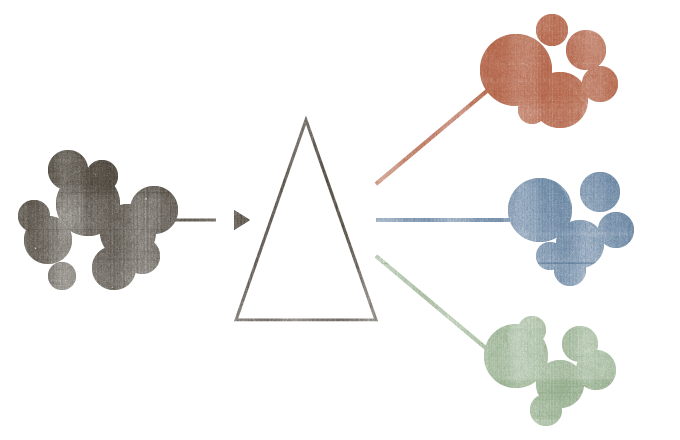
A student in my classroom hears “solve for the missing number, show your work, and explain your reasoning” and processes the first instruction. The rest drops. Three tasks disguised as one, given to a system that can’t hold them all at once.
You learn to decompose. One objective, one visible result, then the next step. I had twelve students with twelve different processing profiles, and every one of them had a different definition of what progress looked like. The structure has to hold at every level without anyone needing to ask.
I grew up watching my father coordinate fifty trades on a construction site. Before I had language for information architecture or design theory, I understood that a structure either holds or it doesn’t. The difference is usually in the joints. I see where things meet and where load transfers. I can usually tell where the failure will happen before it does. That’s what I mean by processing profile.
My wife knew exactly what separated her jewelry from mass-market product. The quality was real. Then you would land on her Shopify store. Same grid as every other template. Same hierarchy. A ring from a premier manufacturer sat in that grid the same size as a $15 drop-shipped piece. The detail work disappeared.
She didn’t see it. She knew what the product was, so the screen looked fine to her. A stranger landing on that page would feel something was off before they could name it. I saw it because I could read the code and the photograph at the same time. So I built Aiden Jae as one integrated system: brand identity, photography direction, Shopify architecture, packaging. The code respects the photograph instead of overriding it. When a customer sees the actual texture of recycled gold under honest light, they’re seeing the cost structure and the production standard without reading a word.
In 2013 I walked into a company and found a Windows Forms application. Desktop-only. OS-dependent. The software was genuinely good: thirty years of decisions without drift, made by the person who wrote it in his dorm room and had been running it ever since. It served some of the largest recruiting organizations in the world.
The software was healthy, but the delivery layer was going to strand it within a few years. Desktop-only meant the platform couldn’t follow its users into a world going browser-based. The people running it were too close to see the constraint. They saw what worked. I saw where it was going.
I made the case for the browser. Then I built the front end from scratch: modular JS framework, full SCSS design system, information architecture across one of the most complex recruiting platforms in the industry. Twelve years later, the platform still runs inside organizations you would recognize. Encore is twelve years of proof the call was right.
Standing in a room of 3,000 people at Twilo while Sasha played a six-hour set, I could feel the sequence working. He was designing peaks and valleys hours in advance, and the whole room was arriving at the same emotional place at the same time without knowing it was constructed. I feel the pacing, the transitions, the points where attention shifts. It shows up in how I sequence a page, structure a product flow, build a brand encounter.
Breakfast was taking 90 minutes. Four people, every meal a decision tree nobody had the bandwidth to run by 7 AM. The processing profile doesn’t shut off at the office door. I read the household the same way I read a platform or a classroom: who needs what, where is the friction, what structure removes decisions people don’t have the energy to make. So I built meal systems, morning routines, grocery defaults. The accommodation move applied to the place that needed it most.
Now breakfast takes 25 minutes and nobody has to make a decision before coffee.
This site was compiled from three years of my conversations. 52,881 documents of thinking out loud, mined by the tools described on this site, evaluated against lenses extracted from real practitioners, assembled under voice rules derived from how I actually talk. I built the workbench from AI tools the way a woodworker builds a bench from hand tools. Every page went through the voice pipeline, the lens evaluations, the traversal system. The tools did analysis. I made the decisions.
The thread across all of these is accommodation, and it runs in both directions. The student who can’t hold three instructions needs the task decomposed. The product whose quality disappears on screen needs its display system redesigned. Same with the platform stranded on the wrong delivery surface, or the household that burns 90 minutes on breakfast because nobody has the bandwidth to choose. In each case, the first move is the same: figure out what the system receiving the work actually needs.
But there’s always a second accommodation happening. My student also needs permission to speak before organizing her thoughts. My wife needs to show her work without performing for the camera. And I need to think out loud into a voice note without structuring it for the model first. The friction on the input side matters as much as the structure on the output side.
In AI work, that second accommodation is the same move: get the thinking out of your head with as little friction as possible. Talk, dictate, think out loud. The tools structure things for the model. The low-friction input preserves what the maker actually meant. Both exist because the same question applies in both directions: what does the receiving system require, and what structure meets it.
In every case, the people closest to the work couldn’t see the gap because they were focused on what they needed the system to do. The shift was learning to read the other system in the room, the one receiving the work, and designing for what it could actually handle.
That shift started in a self-contained classroom in Sunset Park, Brooklyn, and it applies to every material I’ve worked in since. I wrote up the thinking as accommodation design. FormWork is how I actually run it. And this site is what happens when I point both of them at my own work, which turned out to be the hardest application because I kept confusing what I wanted to say with what the page needed to hold.
Systems
The tools I built to run the methodology.
FormWork
The Accommodation Design Process
The accommodation design process. Named from concrete construction: the temporary structure that holds the tools in position while the work is wet. You dump your thinking. The tools structure it. Dumps become source material. FormWork coordinates them. Out comes the work. The formwork comes off.
Read →
LensArray
Multi-Perspective Evaluation and Generation
Evaluation and generation through extracted practitioner lenses. Staff each layer with perspectives you trust, run them independently, read the convergence. The tensions between lenses surface the decisions that actually matter.
Read →
SavePoint Syntax
Semantic Markup for Turning Points in Thinking
Semantic markup for cognitive waypoints. Marks where understanding shifts before the context closes. Each savepoint carries enough semantic payload to orient you or the model when the session is gone. v3.2 adds a context field for self-contained reconstruction, discovered through real traversal across months of conversation logs. Open source.
Read →
Research
The thinking formalized. Published papers with DOIs on Zenodo.
AI Governance as Accommodation Design
A Pedagogical Framework for Human-AI System Architecture
A whitepaper applying special education pedagogy to AI system architecture. Rather than constraining behavior, accommodation design asks what both systems in the room actually need: the model's processing constraints and the human's.
Read →
Input Inversion
Why Unstructured Human Thinking Produces Better AI Output
A whitepaper challenging the foundational assumption of prompt engineering: that quality AI output requires structured human input. Three years of applied evidence demonstrates that raw, unstructured thinking produces better results when purpose-built tools handle the translation.
Read →
Lens Extraction
Decomposed Evaluation Through Practitioner-Derived Criteria
A whitepaper proposing lens extraction: a protocol for extracting named practitioners' evaluative frameworks, codifying them as testable criteria, and running multiple lenses independently against the same work. Where they disagree is where the maker's judgment is needed.
Read →
A Different Kind of Harness
AI as Cognitive Prosthetic Through Mutual Accommodation
A whitepaper proposing that AI is most productive as a cognitive prosthetic: an extension of the practitioner's thinking through mutual accommodation. The model extends cognitive reach. The practitioner directs cognitive intent. Purpose-built interfaces handle the coupling.
Read →
Semantic Flattening and the Case for Human-Marked Importance in AI Memory
Why Machine-Scored Memory Systems Erase What Matters Most
A whitepaper arguing that semantic importance in AI memory is a relationship between content and intent, not a property of content alone. Presents Savepoint Syntax as human-marked semantic hierarchy and contrasts it with machine-determined approaches.
Read →
Voice Governance
Generation Constraints vs. Post-Hoc Filtering in AI-Mediated Writing
A whitepaper arguing that voice constraints applied during AI text generation produce structurally different output than the same constraints applied as post-hoc filters. Presents a forty-rule voice protocol developed over three years of applied practice.
Read →
Free Tools
Four tools you paste into ChatGPT, Claude, or Gemini. They change how the conversation works.